Price every job the way it’ll get built.Price the client’s schedule. Send it back in their own Excel.Measure the run. Work out the dig. Price it from your own rates.Get the tender out on time, and know what’s still open.Run every job the way it gets built.Price civil work the way it’ll get built.

Construction estimating and job planning for New Zealand contractors

Animation of Stralos, simplified: item 3.01 on an example job, from the tender pack to the client’s own workbook, priced
  1. Before: the rate is typed again into the client’s sheet, $349.96 instead of $439.96.
  2. Tender in: their schedule comes in with its numbering kept, so 3.01 stays 3.01.
  3. On the map: council pipes and property boundaries on LINZ aerial.
  4. Measure: 219.50 m traced on the drawing, against 220 m scheduled.
  5. Price: the trench, the crew at 30 m a day and the quarries nearby give $397.69 a metre at cost.
  6. Check and send: a tender review finding quotes the page it came from, and their Excel goes back priced.
  7. Plan it: the item on the tender programme, and what you’d need to hire.
See it recorded

An animation of Stralos, simplified, following item 3.01, 220 m of DN300 stormwater pipe, on an example job, Riverbend Stage 3. Recorded clips of each step are further down the page.

  • Before: the rate is typed again into the client’s spreadsheet as $349.96 instead of $439.96, leaving 220 m $19,800 short.
  • Tender in: the client’s schedule is read from the tender pack with its numbering kept, so 3.01 stays 3.01.
  • On the map: council pipes on your map. The council’s pipes and the property boundaries on LINZ aerial, where the job connects.
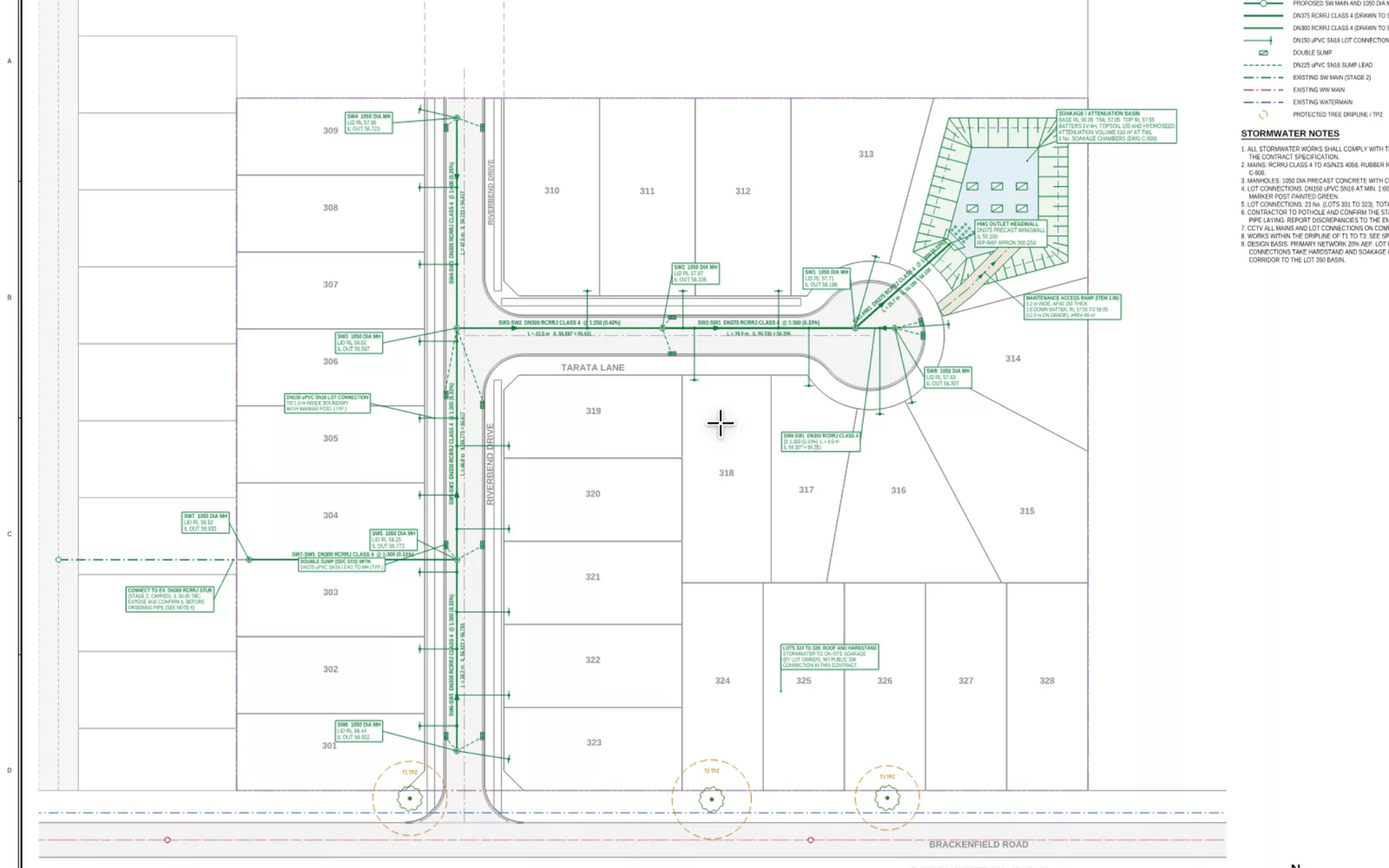
  • Measure: the runs are traced on the drawing, 219.50 m measured against 220 m scheduled.
  • Price: quarries near the job, by road. The trench works out 141.75 m³ of excavation, the crew lays 30 m a day for 7.33 days, and it costs $397.69 a metre to lay.
  • Check and send: a tender review that quotes the tender documents, here the page a finding came from, then their Excel, back priced: 3.01 at $439.96 a metre, $96,791.20.
  • Plan it: the item lands on the tender programme, and the plant pool shows two 5.5 t excavators to hire.
A tender review that quotes the tender documents. Then their Excel, back priced. Animation of Stralos, simplified. Example job. Recorded clips below.

Measure it off the drawing. Price it from your own crews and nearby quarries. Send it back in the client’s own Excel. Then programme the job from your price.Measure, price and send their Excel back priced.

Start free on your next tender

14 days free. No card. Then NZ$249 per user per month, incl GST.

Built with a working Canterbury and Otago civil contractor, and used on its own tenders.

One job, start to finish

Riverbend Stage 3: 28 lots, civil works, with two weeks to close. The run gets measured off the drawing, the dig worked out in a trench sheet, and the rate typed into the client’s schedule and the days into the programme. Every retype is a chance to get it wrong. Here’s the same job in Stralos.

Loops recorded in Stralos. Example company, job and rates.

1. The tender lands.

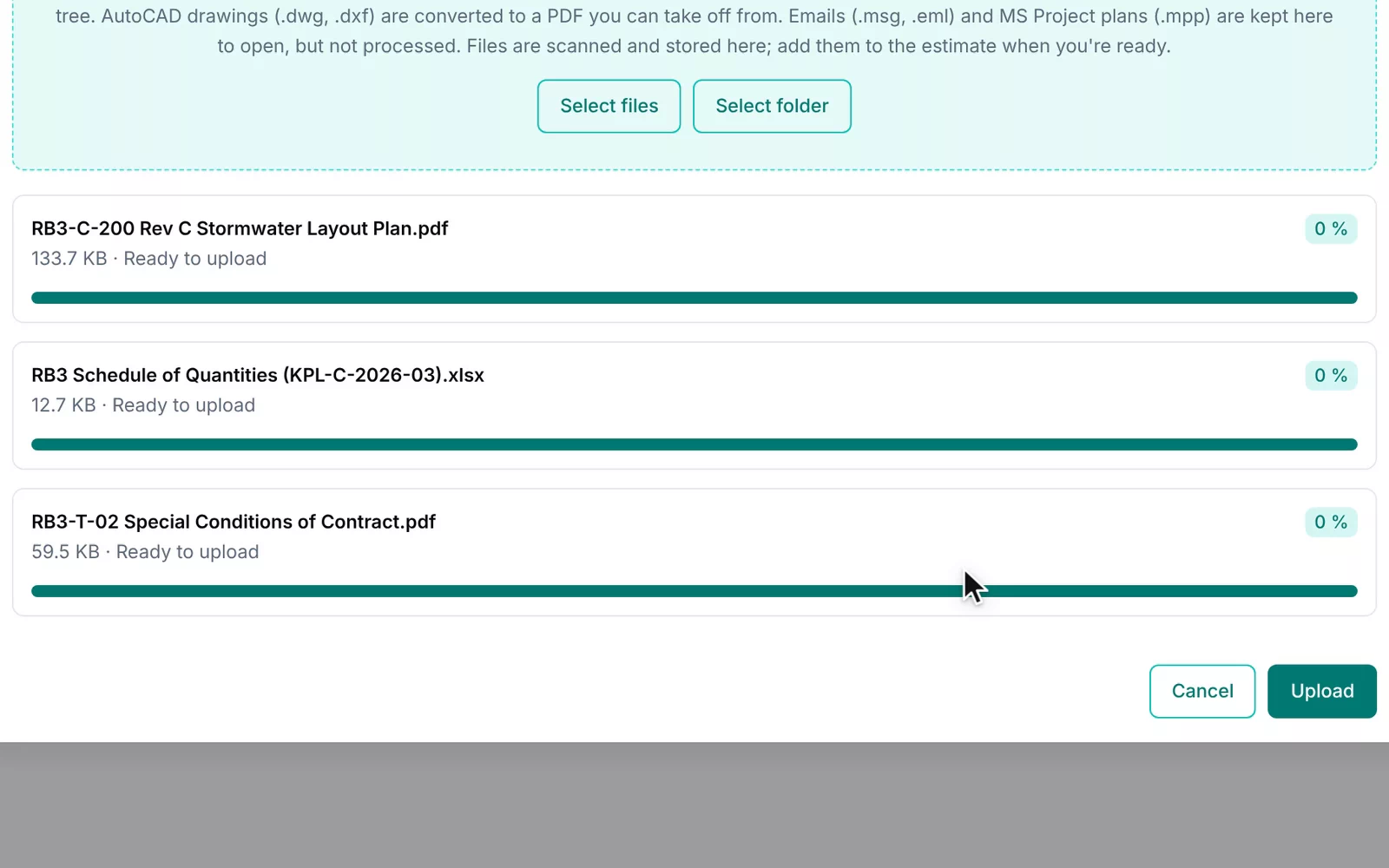
Drop in the tender pack. Stralos reads the client’s schedule and suggests the items with their numbering kept exactly, so 3.01 stays 3.01. Accept them and the numbering locks.

Recorded in Stralos: the tender pack dropped in, the client’s schedule suggested, Accept all, and row 3.01 kept at 220 m as the client wrote it.

Without Stralos: copying 50 lines from their spreadsheet into yours, then checking you didn’t skip one.

The detail
  • Each suggestion shows the page it came from, and nothing goes in until you accept it.
  • Sections are made for you, and a bundled line splits into parts without losing where it came from.
  • Drawings, specs and price lists live in one place with the job.

2. Measure it and price it.

Start with what’s already in the ground

Find any New Zealand address on LINZ aerial, turn on the property boundaries and the council’s stormwater, wastewater and water pipes, and click a pipe for its size and material. Coverage: more than 25 councils and water providers.

Recorded in Stralos.

Recorded in Stralos: Cathedral Square, Christchurch, on LINZ aerial with property boundaries and the council’s pipes, then a water main’s size and material.

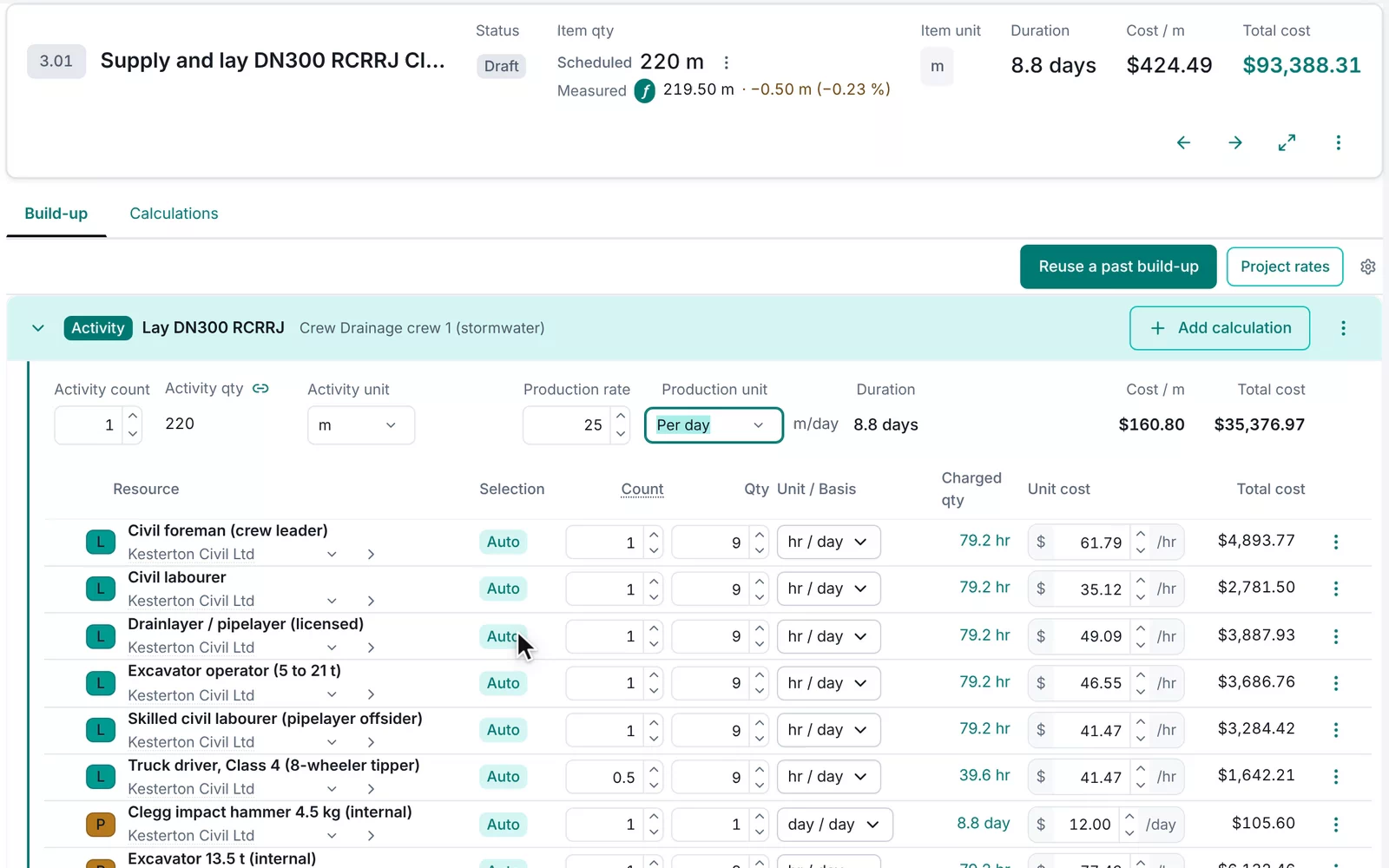
Their schedule says 220 m of DN300. It doesn’t give you the trench. Trace the runs to check their quantities and catch where they’re short, like 3.07, then set up the trench once and it works out what comes out of the ground, what goes back in and what gets carted away. Set the crew and how many metres a day they lay, and the hours, days and cost per metre follow.

Without Stralos: measuring in one window, typing it into another, a trench spreadsheet only one person understands, and production rates hiding in a formula nobody checks.

Recorded in Stralos: the DN300 stormwater runs are traced on the drawing, and the length ticks up.

Calculators that think like you dig

Ground layers, bedding with the pipe netted out, backfill from the dig, and what’s carted away, worked out from the length you measured. Turn it in 3D.

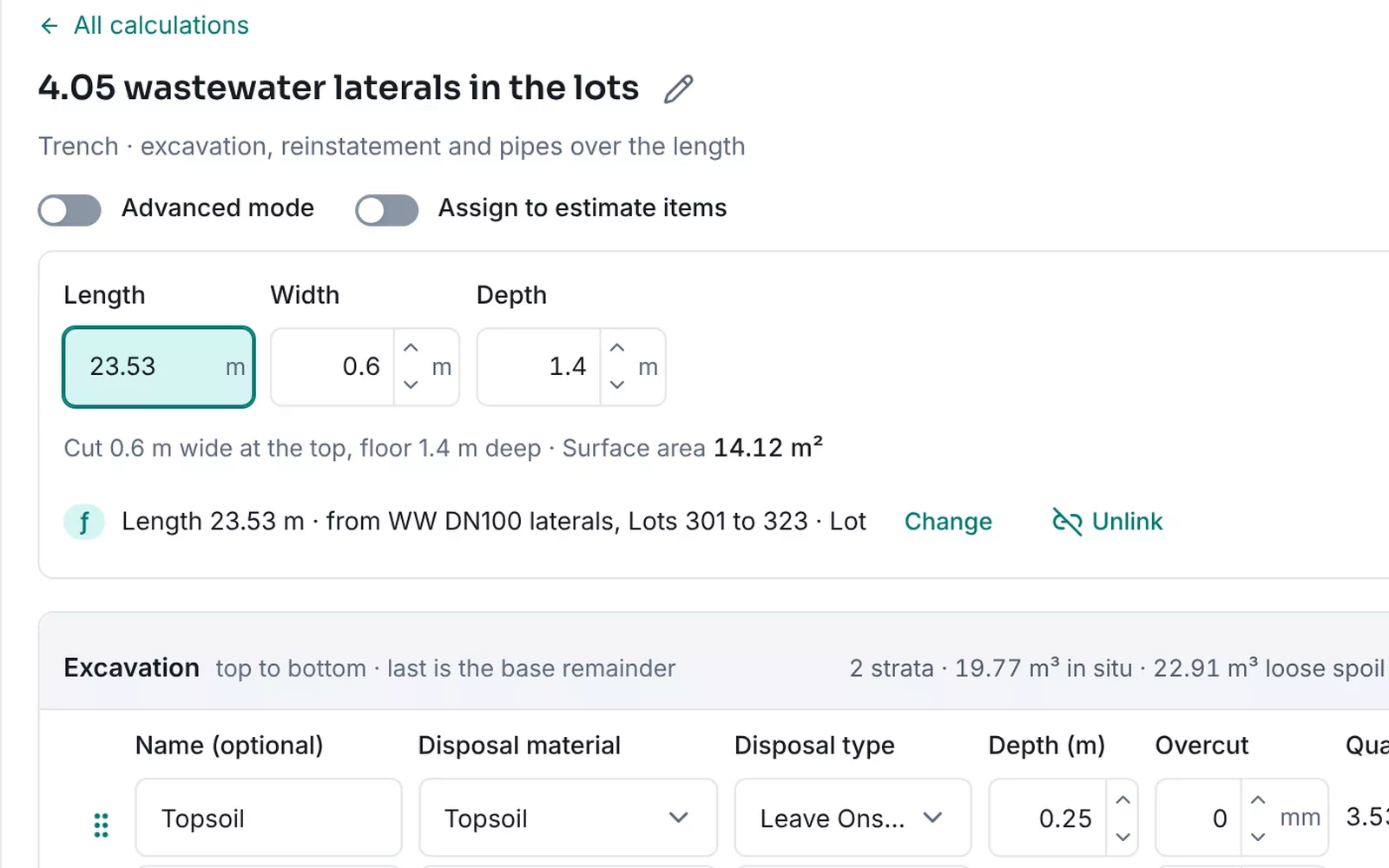
Recorded in Stralos: the 4.05 lateral trench in the lots, topsoil and gravel reused and the surplus carted, then the trench turned in 3D.
Recorded in Stralos: in the build-up the production rate changes from 25 to 30 m a day, and the duration, hours and cost per metre update.
The detail
  • The trench can take its length straight from the takeoff.
  • Connecting to an existing main? Measure it on LINZ aerial straight off the council’s pipe records, with the property boundaries on.
  • Each layer of ground has its own bulking, and the bedding allows for the room the pipe takes up.
  • Move a point, change the depth or swap the pipe, and every quantity that depends on it follows.
  • Prices fill from your suppliers within the distance you set, and the closest quarries are ranked by road and drive time.
  • Price pipe by the length and Stralos charges whole stock lengths for each run.
  • Drop in a supplier’s price list and Stralos matches it to your library. You check each match before anything changes.
Stralos's Closest quarry suppliers panel for Riverbend: Waimakariri Aggregates at 11.7 km and 13 minutes, cheapest overall; Kānuka Aggregates at 12.2 km, cheapest for AP20; Pūhā Shingle at 27.4 km, cheapest for AP65.
Quarries near the job, by road. The closest suppliers by road, with drive time, which materials each is cheapest for, and what their materials would cost on this job.
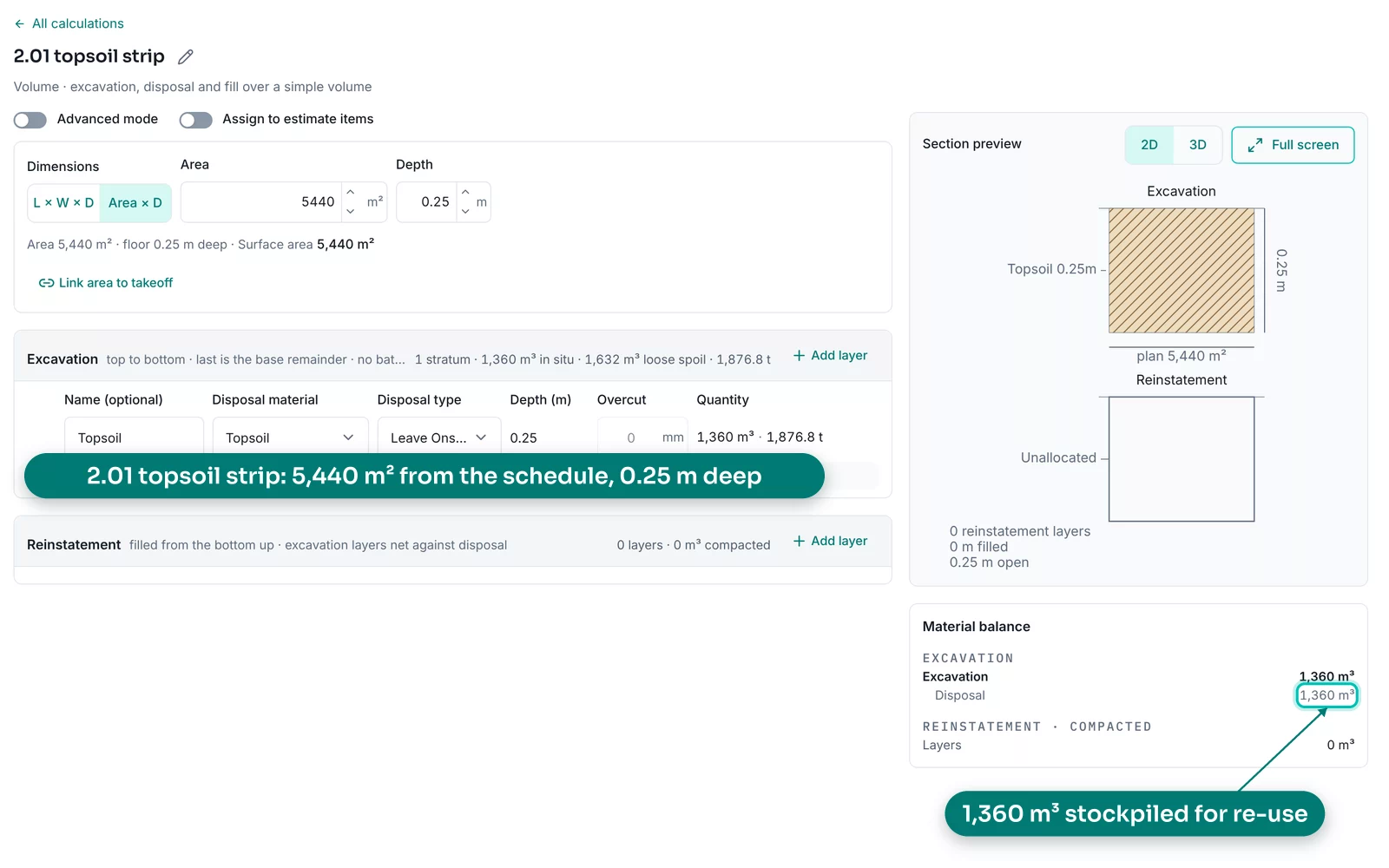
The Volume calculator: 2.01 topsoil strip, 5,440 m² at 0.25 m deep, 1,360 m³.

3. Check it with AI, then send it back.

Before it goes, the tender review checks scope gaps, clauses and conditions, quantities against your takeoff and, once you’ve priced tenders in Stralos, pricing against your own recent ones. Findings from the documents quote the page. Then their schedule goes back in their own Excel, priced.

What the tender review goes through

  1. Reads your tender documents
  2. Gathers your estimate and your recent tenders
  3. Checks scope, clauses, pricing and quantities
  4. Checks each finding’s quoted passage against the page it came from

Usually 2 to 5 minutes.

Without Stralos: finding the tree clause at the pre-start meeting.

The detail
  • Quantities against your takeoff catch 3.07: the lot connections the schedule calls 201 m and your takeoff measures at 223.7 m, ready to query before questions close.
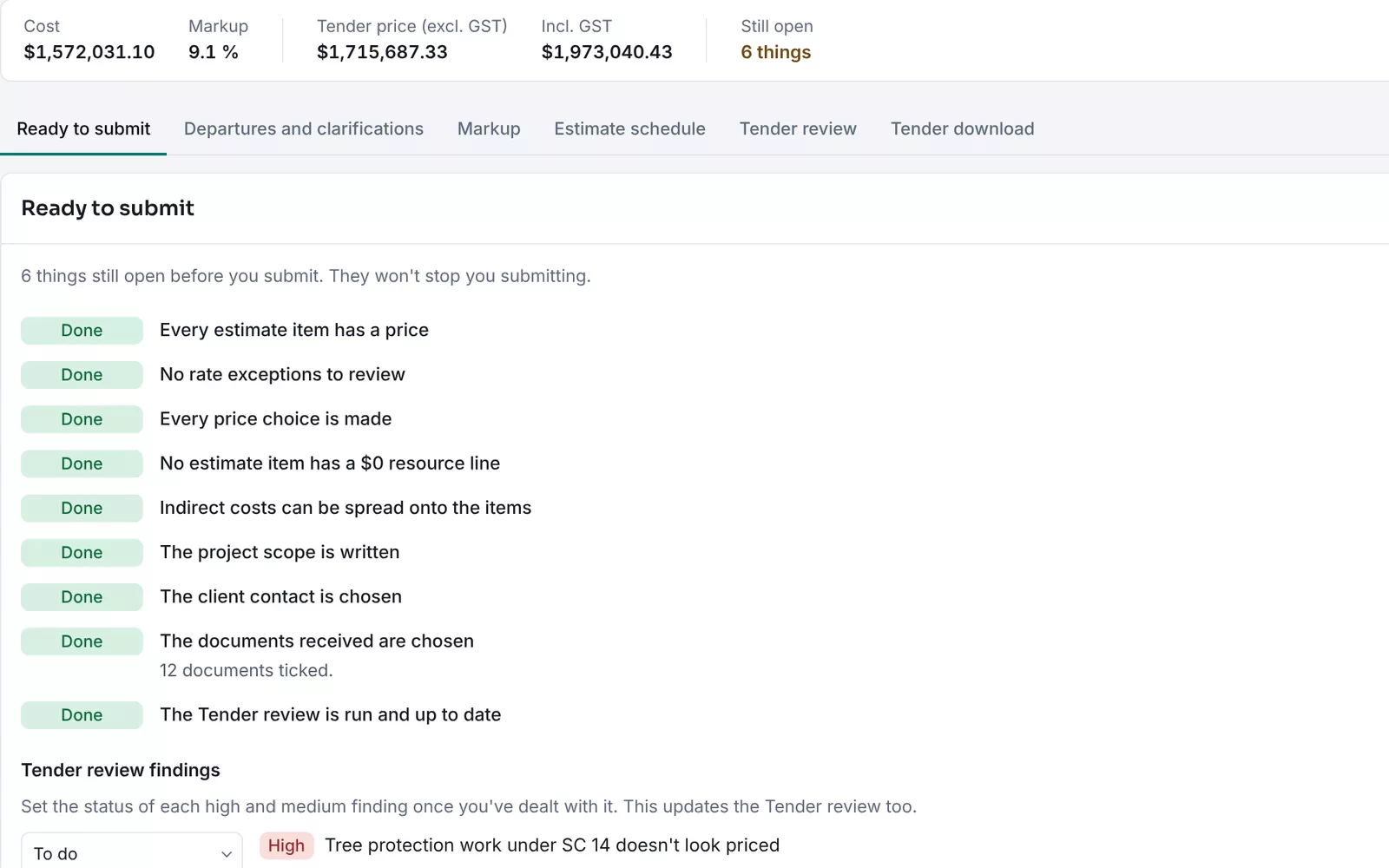
  • Ready to submit lists what’s still open: unpriced items, $0 lines and rate exceptions.
  • Their schedule goes back in their own Excel with the numbering untouched, alongside a branded PDF.
  • Send each person their own private link, and Stralos tells you the first time they open it. The revision you sent is kept exactly as sent.
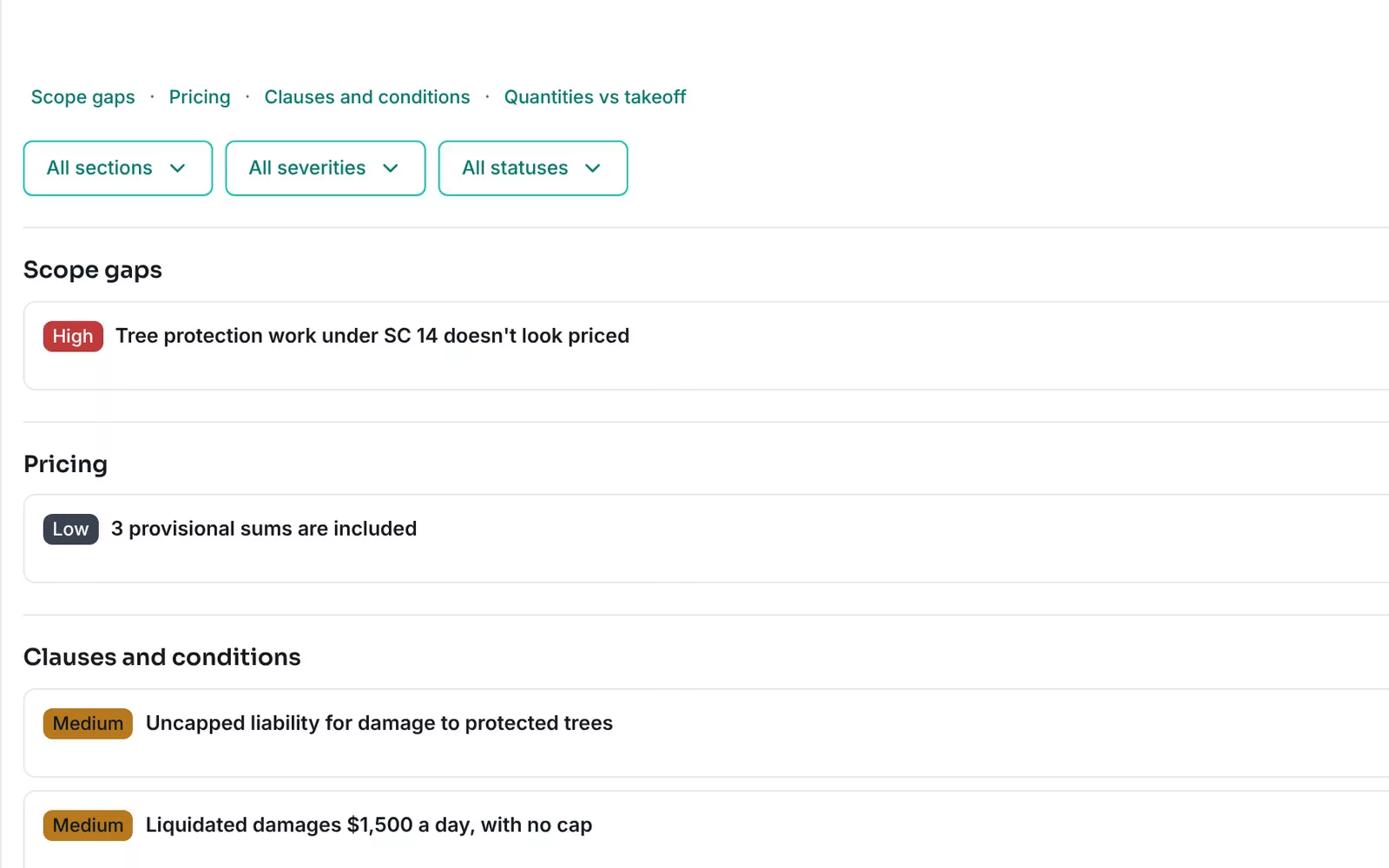
Recorded in Stralos: the tender review’s findings on Riverbend, from tree protection under SC 14 and uncapped liquidated damages to aggregate prices that expire, then the SC 14 citation opening the special conditions at the clause, then 3.07’s quantity against the takeoff.
Recorded in Stralos: Ready to submit with what’s done and what’s open, the tender download as PDF, Excel or Word with or without the breakdown, the client’s own workbook with section 3 priced, then a private share link for one person.

What it catches

  • Scope gaps

    Work the documents ask for that isn’t priced

    Like tree protection buried in the special conditions, found before the pre-start, not after.

  • Quantities

    Their quantity doesn’t match your takeoff

    201 m scheduled, 223.7 m measured. Query it before questions close.

  • Clauses and conditions

    Liquidated damages, insurance and one-sided clauses

    Spotted while you can still price the risk or qualify it.

  • Clauses and conditions

    Supplier prices that run out before the work’s done

    Like an aggregate price list that ends partway through the job. Spotted while you can still get a project quote.

  • Pricing

    Trucks that can’t move the material

    Truck hours well short of the spoil and metal you’ve priced, or plant charged twice.

  • Pricing

    Prices that stand out from your recent tenders

    Markup and rates checked against your own past jobs, once you’ve priced a few in Stralos.

Ask Doug about your estimate

Example answers

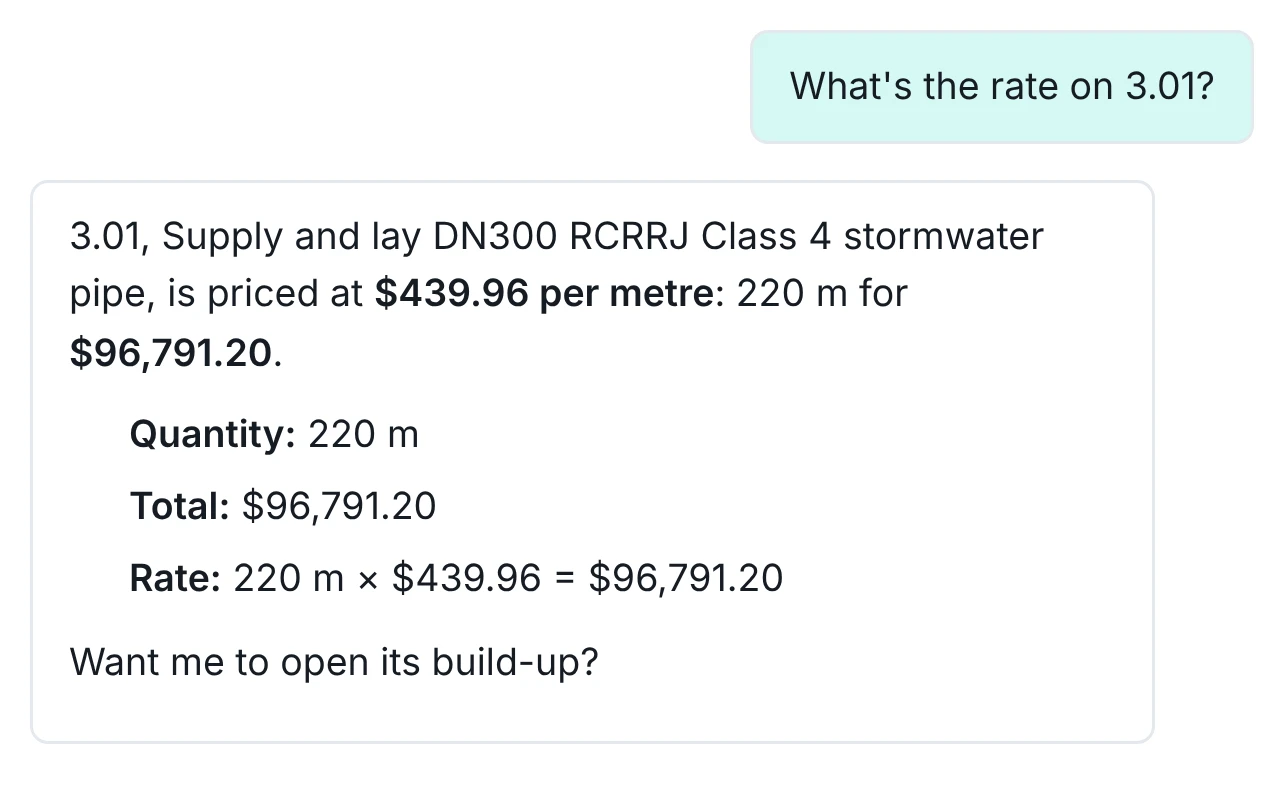
Doug, asked “What’s the rate on 3.01?”, answers that 3.01, supply and lay DN300 RCRRJ Class 4 stormwater pipe, is priced at $439.96 per metre: 220 m for $96,791.20.
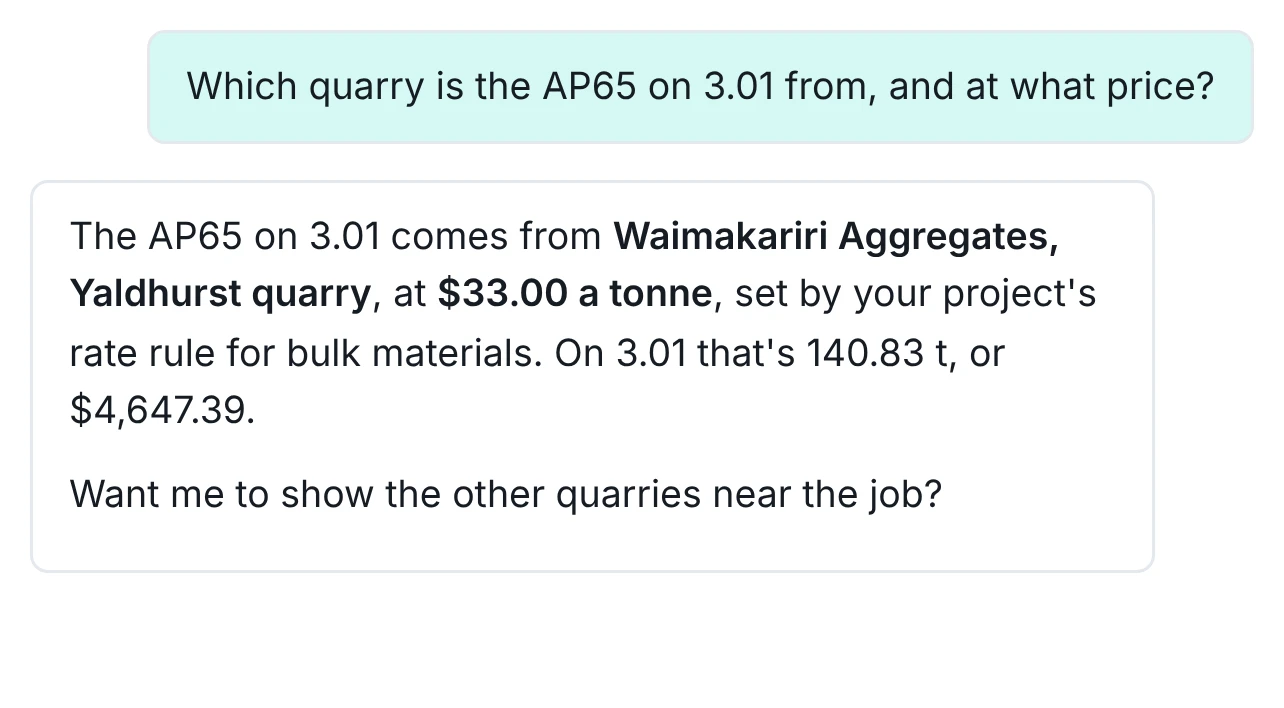
Doug, asked “Which quarry is the AP65 on 3.01 from, and at what price?”, answers Waimakariri Aggregates, Yaldhurst quarry, at $33.00 a tonne, set by the project’s rate rule for bulk materials: 140.83 t on 3.01, or $4,647.39.

Doug can get things wrong, so check anything important.

Start free on your next tender

14 days free. No card. Then NZ$249 per user per month, incl GST.

4. Win it, then plan it.

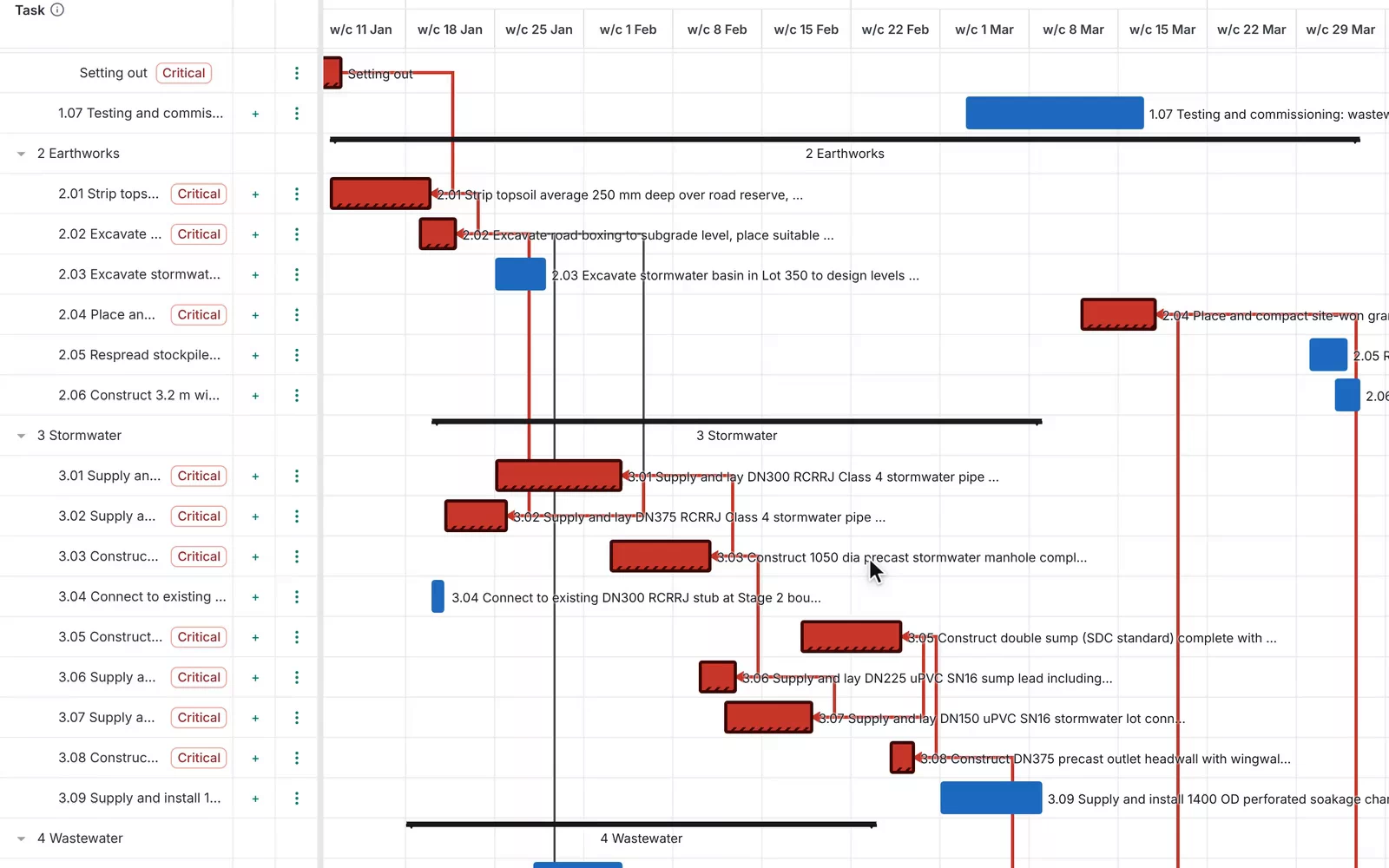
Every item lands on the tender programme, with bar lengths from your crews’ production rates, brought up to date in one click. Pencil in the jobs you’re still pricing to see what you’d need to hire. Win one, turn it into the project programme and book your crews, people and plant against it.

Recorded in Stralos: the tender programme with bars from the crews’ production rates, then the scheduler week view with crews, plant and a Hire 2 flag.

Without Stralos: rebuilding the programme from scratch the week you win.

The detail
  • On the project programme, the critical path shows in red, and the whole programme, people and plant included, exports to MS Project.
  • When bookings outstrip your fleet, the plant pool shows how many you’ll need to hire.
  • Licences, tickets, WOF/COF and rego expiry for your people and machines, in one report.
Start free on your next tender

14 days free. No card. Then NZ$249 per user per month, incl GST.

Built by people who price and build the work

James and Ben run a civil, utilities and traffic management contractor working across Canterbury and Central Otago, and price its tenders in Stralos. Mike and Graeme are experienced software developers who build it, so Stralos comes from people who price the work and people who build software.

  • James Macdonald

    Founder

    James is CEO of Atlas Group, a civil, utilities and traffic management contractor operating across Canterbury and Central Otago. His experience spans business leadership, forecasting and construction operations, bringing a contractor’s perspective to Stralos and the challenge of keeping estimates, project delivery and financial performance connected.

  • Ben Hopewell

    Founder

    Ben is General Manager of Atlas Group, overseeing its civil, utilities and traffic management operations. He previously held regional management roles at a national civil company and led an ASX-listed company. He brings practical experience coordinating people, plant and projects, helping shape Stralos around the everyday needs of construction teams.

  • Mike Ryan

    Founder

    Mike has spent his career turning complex business requirements into software and reporting people actually use. He spent more than a decade at Vault and then Damstra Technology in customer support and reporting, then nearly five years at a business intelligence consultancy. Alongside that he founded RapidCert, a contractor prequalification platform, which he built with Graeme, and he runs Ryan Analytics and a software and web development business.

  • Graeme Ainsworth

    Founder

    Graeme has spent more than 25 years building software for industries where getting it right matters. He spent 14 years at Vault as CTO, growing it into a health and safety platform used by NZX and ASX listed companies and 100+ councils. He went on to be CTO at Herd-i, using AI to spot health problems in dairy herds, and then built and launched RapidCert with Mike, a contractor prequalification platform.

One price, everything that’s live

NZ$249 per user per month, incl GST

NZ$216.52 + GST

Less than a day of an estimator’s pay each month.

  • Includes everything that’s live in Stralos today: takeoff and calculators, build-ups and rate libraries, schedule and tender review, tender output, programme and scheduler, and Doug, the built-in assistant.
  • You pay for each person with a Stralos login, not for the crews, workers and machines you schedule.
  • 14 days free for up to 10 users. No card. Cancel any time.
  • Start now and you’ll be set up before the Christmas break, ready for the new year’s tenders.

What’s next

Today Stralos covers winning the work and planning it. Next come running the job, getting paid and your accounts.

Being designed with a Canterbury and Otago contractor’s site and office teams.

  1. Run it

    In the order beta contractors ask for them

    • Field team access, so the crew on site works from the same job.
    • Time tracking and job costing as the job runs.
    • QA tracking, kept with the job.
  2. Get paid

    In the order beta contractors ask for them

    • Variations, with the messages about each one kept together.
    • A variation check before it goes to the client.
    • Progress claims from the same job.
  3. Accounts

    In the order beta contractors ask for them

    • Connections to Xero and MYOB.
    • So jobs and claims don’t get typed into your accounts again.
Start free on your next tender

14 days free. No card. Then NZ$249 per user per month, incl GST.

Not pricing a tender right now? Tell us what you’d use first.

What you’d use first

Questions

Will it handle how we price our work?

Build-ups from your own crews, plant, materials, subcontractors and disposal; production rates; trench, pit and volume calculators; NZS 3910, 3915, 3916, 3917, NZIA, Master Builders, Certified Builders, NEC and FIDIC tenders, with the on-site and off-site overhead percentages set per project.

Does it work with the client’s Excel schedule?

Yes: import it with their numbering locked, then export your rates back into their own workbook. (Each item needs to match one row of their sheet. Split items roll back into their parent’s row.)

Can I bring my rates and supplier price lists?

Drop in Excel, CSV or PDF price lists; Stralos matches each line to your library and you check each match before anything changes. Labour and plant rates go in once and are reused on every job.

What drawings can I measure on?

PDF drawings, with the scale checked against a dimension you know. With no drawing, measure on satellite or LINZ aerial map sheets, with council pipe layers where they’re available (not yet Dunedin, Invercargill or Auckland stormwater).

How long until my first priced item?

Your company starts empty, so bring a supplier price list and your labour and plant rates. Allow 30 to 45 minutes to a first priced item.

I’m an owner-operator. Is it overkill?

One seat is enough to price every tender you do. Use the parts you need.

What does open beta mean for a live tender?

Estimating, tender review and output are live and used on a working contractor’s own tenders. The programme and scheduler are live too. Things will keep improving, and everything you set up stays with you when you add a card at the end of the free 14 days.

What’s coming, and when?

Next come running the job (field team access, time tracking, job costing and QA tracking), getting paid (variations, a variation check and progress claims) and Xero and MYOB. They’re being designed with a Canterbury and Otago contractor’s site and office teams and will come in the order beta contractors ask for them. There are no dates yet. See what’s next.

Is there an AI assistant?

Yes. Doug, the assistant built into Stralos, can find things in the app for you and propose changes as cards you check and accept. He can’t delete anything. He’s still learning, so check anything important.

Who can see our rates, and where’s our data?

The people you invite see your company’s data. Stralos staff only see it when you ask us to, for security, or when the law requires it, and each time is logged. It’s stored with Amazon Web Services in Sydney. AI features use providers whose terms don’t let them train on your data.

Can I get my work out if I stop?

Tenders download as PDF, Excel or Word, and the client’s schedule exports back into their own workbook.

What happens when the 14 days are up?

Add a card to keep going, and your paid subscription starts straight away. If you don’t, your company can still view its information for 7 days but can’t make changes. After that, Stralos is paused until a card is added.

Who counts as a user?

Each person in your company with access to Stralos, including people you’ve invited who haven’t signed in yet.

Can I cancel?

Yes, at any time, in the app or by getting in touch. Cancelling takes effect at the end of the month you’ve paid for.

Start free on your next tender

14 days free. No card. Then NZ$249 per user per month, incl GST.

Checking the beta…

Start free on your next tender

Start free on your next tender

14 days free. No card. Then NZ$249 per user per month, incl GST.